Manufacturing an Experimental Model Water Turbine Blade Using Metal 3D Printing
A Faster Route to Water Turbine Development
Water turbine development is a process in which precision plays a critical role. Every new design must undergo thorough testing to verify that the calculated parameters correspond to the component’s actual behaviour under operating conditions. The conventional production of model blades through casting, machining and polishing was time-consuming and slowed down the validation of new designs.
Litostroj Engineering therefore sought a way to make the production of these components faster and more efficient.
The Brain4Industry Solution
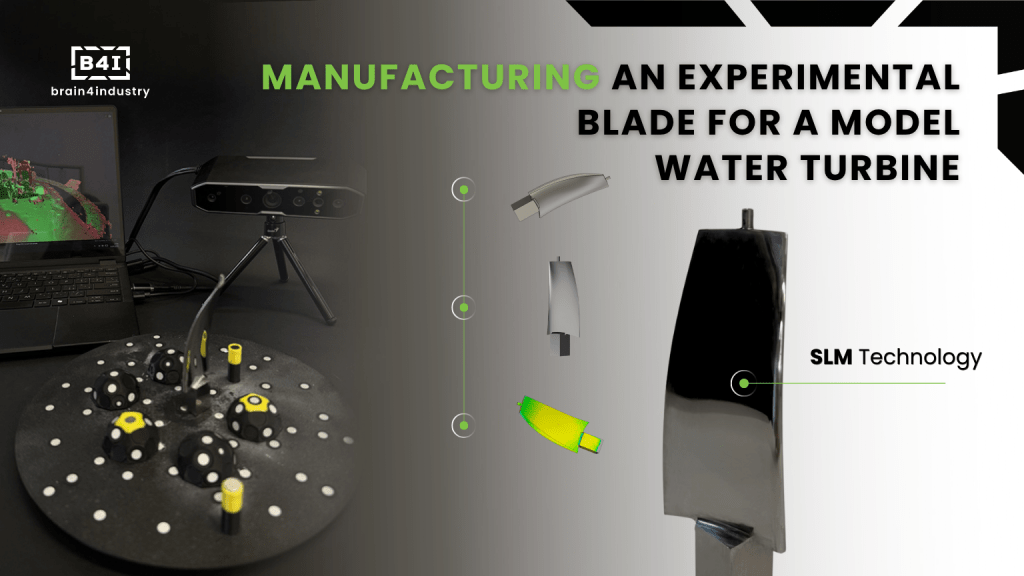
Additive manufacturing was selected as an alternative to conventional manufacturing methods for producing the model blade. The solution included optimisation of the CAD model, production of the part using SLM technology, subsequent CNC machining, final manual polishing and verification of geometric accuracy using 3D scanning.
The aim was to determine whether additive manufacturing could achieve the same or higher quality of the finished part as conventional manufacturing methods while offering a faster and more efficient route for future water turbine development.
Project Challenges
The project was defined by several key technical requirements:
- Adapting the design for additive manufacturing and subsequent CNC machining.
- Producing an accurate thin-walled profile using metal 3D printing.
- Eliminating the risk of blade deformation during machining.
- Maintaining geometric accuracy throughout manufacturing and finishing operations.
- Minimising material porosity.
- Achieving a mirror-smooth surface suitable for testing.
Project Result
At Brain4Industry, we successfully manufactured a model water turbine blade using metal 3D printing (SLM). The project resulted in a shorter development time, optimised manufacturing steps and an accurate functional model that met the demanding technical requirements for subsequent testing.
Benefits for the Client
- Testing could begin significantly earlier.
- The design team received feedback on the new design sooner.
- Any necessary modifications could be addressed without a long wait for another manufacturing cycle.
- The entire development process moved more quickly from design to validation.
The ability to rapidly validate a new design and respond to test results can significantly shorten the overall development cycle and accelerate the implementation of innovations in practice. This is precisely where additive manufacturing can provide a significant advantage.
Do you need to shorten development time or validate a new product using additive manufacturing? Contact us, and together we will find the most effective solution for your project.