Development of Premium Titanium Cycling Components
From Concept to a Five-Product Line Using Metal 3D Printing
When expanding its product portfolio, KODUZ – DUO, s.r.o. wanted to use the benefits of titanium and the design possibilities of additive manufacturing to develop a new high-end product line.
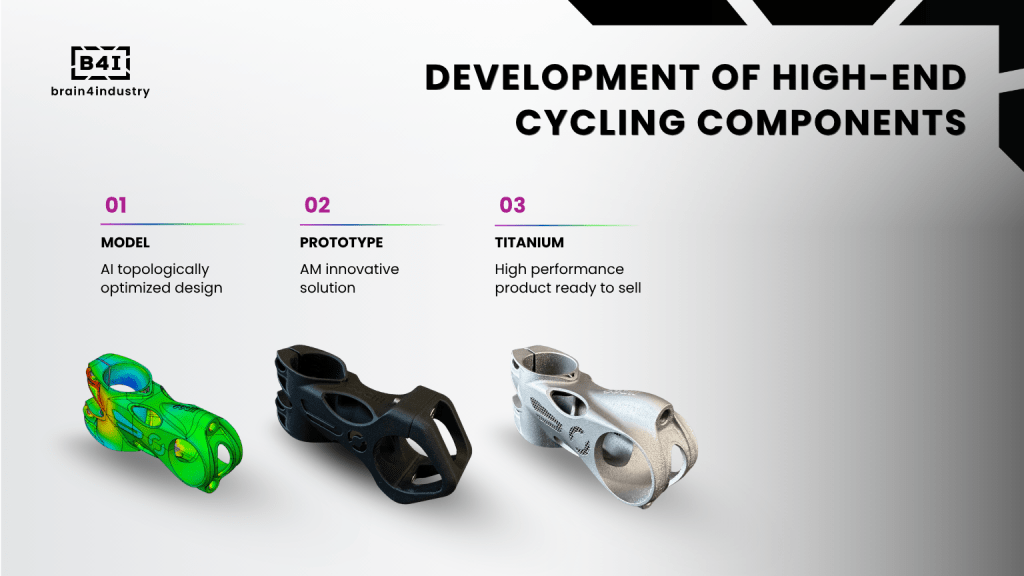
The company turned to Brain4Industry to collaborate on the development of a five-product range of bicycle accessories, including a seatpost, two stems, and two styles of bar ends. All parts were designed for metal 3D printing from the start and connected by one shared organic design.
A project like this is about more than creating the first design. The challenge is to turn an idea into a working prototype without unnecessary mistakes or delays. By testing and improving the design step by step, the team was able to make better decisions throughout the development process.
Brain4Industry Solution
The project covered the entire development process, from the first sketches to the production of the final titanium components. Engineers from CARDAM, a member of the Brain4Industry consortium, designed the components, created the 3D models, and carried out the calculations and simulations. After that came prototyping, metal 3D printing, post-processing, and preparation for physical load testing.
The product was developed in several iterations. Plastic models were used to check the shape, proportions, and ergonomics. These were followed by stainless steel and aluminium prototypes, allowing the design to be refined before producing the final titanium prototypes.
A key part of the project was the Design for Additive Manufacturing (DfAM) approach. Each component was designed specifically for metal 3D printing to reduce the need for support structures, minimize material waste, and limit post-machining. The organic design also helps reduce material usage while giving the entire product range a consistent look.
Project Challenges
The project involved several key challenges:
- Create one consistent organic design across all five components.
- Design each component specifically for metal 3D printing.
- Reduce support structures, material waste, and post-machining.
- Ensure the design could withstand the expected loads during use.
- Meet demanding technical and ergonomic requirements.
Project Results
The project resulted in a complete set of five titanium bicycle components. The final prototypes were made using SLM metal 3D printing and finished by machining important surfaces and bead blasting.
The titanium prototypes are now ready for physical load testing. After the testing phase, the project will continue with serial production and the launch of the new product line.
Benefits for the Client
- Continuous design validation and improvement throughout the development process.
- The opportunity to refine the shape, ergonomics, and functionality before manufacturing the final parts.
- A design optimized for additive manufacturing from the start.
- A complete five-product high-end range with one consistent organic design.
The project demonstrates that the real potential of metal 3D printing is achieved when products are designed for additive manufacturing from the beginning. Integrating design, engineering, simulations, and prototyping makes it possible to develop components that fully benefit from the technology.
Are you developing a new product or looking to use additive manufacturing? Contact us, and together we’ll find the best way to turn your idea into a functional prototype.