How to Print Highly Precise and Even Transparent Parts? The Answer Is SLA 3D Printing
Not all 3D printing technologies are suitable for applications where high accuracy, surface quality, or optical properties are critical. If you require extremely fine details, smooth surfaces, or transparent parts, SLA (Stereolithography) may be the right solution.
What Is SLA 3D Printing?
SLA (Stereolithography) is an additive manufacturing technology that uses UV light to cure liquid photopolymer resin. Unlike conventional FDM printing, which melts and deposits thermoplastic filament, SLA builds parts by selectively curing resin layer by layer until the final model is formed.
Thanks to this process, SLA can achieve significantly finer details and smoother surface quality than most common 3D printing technologies.
Where Does SLA Excel?
The greatest advantage of SLA technology is its exceptional level of accuracy and detail. As a result, it is widely used for manufacturing:
- Medical and dental devices
- High-detail prototypes and models
- Jewelry and casting patterns
- Optical and transparent components
Another major benefit is the ability to produce highly transparent parts. With many other additive manufacturing technologies, transparent materials often appear only translucent. Because SLA parts are formed from liquid resin, they do not contain the air gaps and layer interfaces commonly associated with FDM printing, which can scatter and refract light. As a result, SLA parts can achieve significantly higher optical clarity and transparency.
Why Is SLA a Popular Choice for Medical and Dental Applications?
Thanks to its smooth surface finish and high precision, SLA is well suited for applications where hygiene, accuracy, and product customization are essential. Specialized biocompatible materials are also available for applications such as dentistry.
At Brain4Industry, we have used this technology, for example, in the development of a customized toothbrush for Adéla Dental Care.
What Does the Manufacturing Process Look Like?
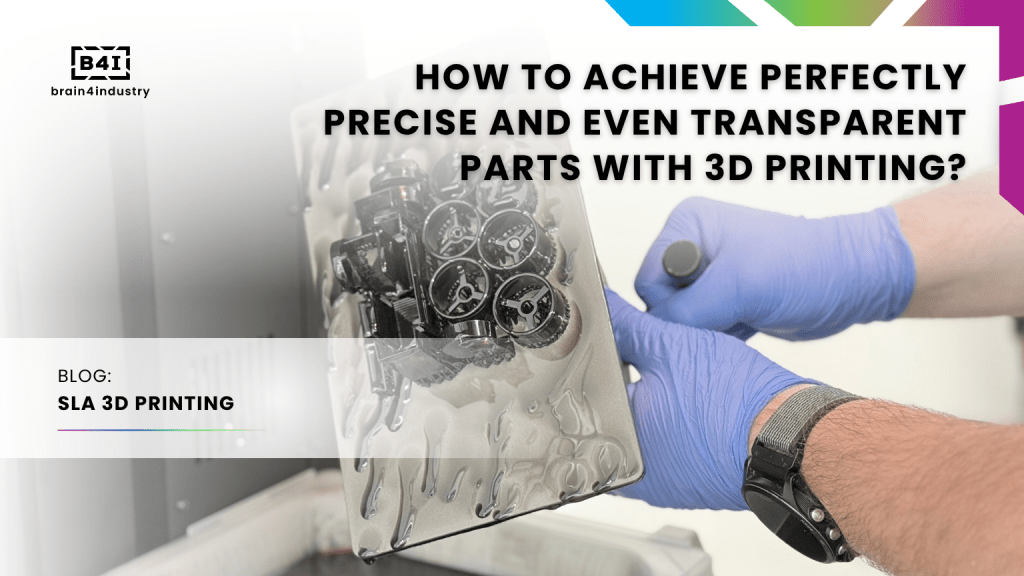
After printing is complete, the part must be cleaned to remove residual resin, support structures must be removed, and the model must undergo post-curing in a UV chamber. Only then does the part achieve its final strength and required mechanical properties.
When Should You Choose SLA?
SLA is one of the best available additive manufacturing technologies when your application requires:
- High dimensional accuracy
- Fine details
- Smooth surface quality
- Transparent components
- Solutions for medical or dental applications
Learn More About Industrial 3D Printing
Discover more about additive manufacturing and the technologies available at Brain4Industry on our AM research and product development page.