Interview: Aerospace & Defence
The defence sector was one of the few industries to record sales growth in 2024. Despite ongoing geopolitical tensions, defence budgets remain available, and the adoption of additive manufacturing continues to increase. Spending on defence technologies is expected to double by 2029. Aerospace, healthcare, and the defence sector continue to be among the leading industries adopting additive manufacturing, with defence expected to remain one of the primary consumers of metal components in 2026.
In 2024, the defence sector was one of the largest investors in additive technologies, with equipment spending growing at an annual rate of more than 20% over the past four years. This upward trend is expected to continue through 2030, driven by further expansion of investments in both metal and polymer technologies in connection with the development of drones, missile systems, and military logistics.
Research and development of new functionalities also plays a significant role, alongside increasing pressure to secure critical components for legacy systems, where component availability is essential to keeping these systems operational.
The aerospace industry, which had been one of the main drivers of additive manufacturing growth in previous years, experienced a slowdown and a decline in equipment sales following a period of rapid capacity expansion, with the market now gradually stabilising.
The aerospace and defence industries represent some of the most advanced applications of additive manufacturing. Every reduction in weight, every design optimisation, and every improvement in reliability has a direct impact on performance, safety, and costs.
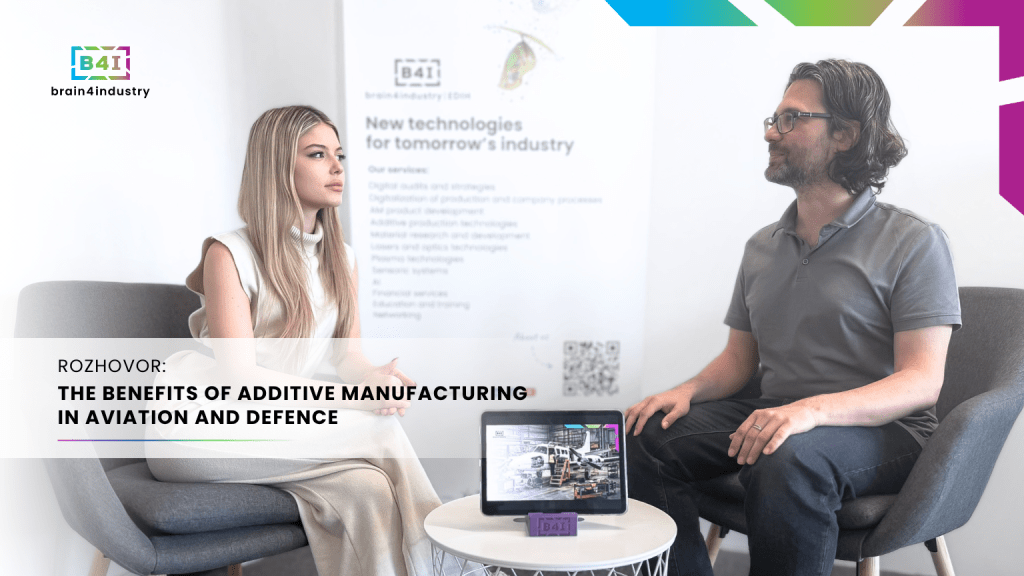
In this interview, Marek Havel, R&D Manager at Brain4Industry, discusses the benefits and future development of additive manufacturing technologies in aerospace and defence with Adelaine Rozinková, PR and Marketing Specialist at Brain4Industry.
Advantages of Additive Manufacturing for Aerospace and Defence Structures
What are the main advantages of additive manufacturing for the aerospace and defence industries?
In the aerospace and defence industries, additive manufacturing offers the opportunity to take advantage of many of its key benefits at the same time. One of the most important is part consolidation – combining multiple components into a single part. This brings several advantages: fewer parts mean fewer potential points of failure, simpler assembly and logistics, and lower overall costs.
Another key benefit is reduced weight and lower material consumption. This is particularly evident in the aerospace industry, where many components are traditionally machined from solid blocks of material. For example, a component may be machined from a solid aluminium block, with only around ten percent of the original material ultimately becoming part of the aircraft, while the remainder becomes waste. Although this material is typically recycled, it is often downgraded to a lower-grade material. Additive manufacturing makes it possible to use material only where it is actually needed.
Small production volumes are another important factor. Aircraft are not manufactured in the same volumes as automobiles or consumer electronics, making additive manufacturing economically viable for this sector.
Another significant advantage is customisation. Aircraft and their components are often tailored to specific customers or mission requirements, and additive manufacturing greatly simplifies this process.
Weight Reduction of Aerospace Structures Through Additive Manufacturing
Can additive manufacturing significantly reduce the weight of aerospace structures?
Yes, and this is one of its most important advantages. By using topology optimization, the weight of structural components can be significantly reduced while maintaining the required strength.
This has a direct impact on aircraft performance. For example, if the weight of a structure is reduced by ten percent, that weight saving can be used for additional fuel, extended range, higher speed, increased payload, or extra onboard equipment.
Weight reduction also creates a cascading effect throughout the aircraft. A lighter structure makes it possible to use a lighter landing gear, a smaller engine, and smaller fuel tanks, reducing the weight of the entire system. The only thing you cannot make lighter is the pilot.
What role do materials play in this field?
One of the major advantages of additive manufacturing is its ability to efficiently process materials that are difficult to machine, such as titanium and Inconel. These materials are widely used in the aerospace industry, but conventional machining is both challenging and expensive. Additive manufacturing makes their use significantly more practical while also expanding design possibilities.
The Role of Additive Manufacturing in Space Missions
Why is additive manufacturing also critical for space missions?
In the space industry, many of the same advantages apply as in aerospace, including weight reduction, part consolidation, design optimization, and efficient material use. In addition, additive manufacturing offers a crucial logistical advantage.
In orbit, for example aboard a space station, the ability to produce a replacement part on demand is a major benefit. Instead of waiting for the next resupply mission, components can be manufactured as needed.
This becomes even more important during long-duration missions, such as those to the Moon or Mars. A journey to Mars can take approximately six to nine months, depending on the relative positions of the planets. If a critical component were to fail during such a mission, delivering a replacement would not be a practical option. The ability to manufacture spare parts directly on site is therefore essential.
Manufacturing Complex Internal Structures and Components
How does additive manufacturing enable the production of complex internal structures, for example in engines and other aerospace and defence components?
It depends on the type of engine and the specific component. Every project begins by defining the design requirements, such as interfaces, connections to adjacent components, and the expected mechanical loads.
The component is first modelled, after which topology optimization can be applied to refine both its geometry and internal structures. At Brain4Industry, we have specialists who develop these optimization algorithms tailored to the requirements of each specific application.
The internal structures are designed to achieve the required properties, such as strength, weight, or thermal performance. When using powder-based additive manufacturing technologies, the design must also ensure that any unsintered powder can be removed from internal cavities after the printing process.
The Impact of Additive Manufacturing on the Development of Defence Technologies
Does additive manufacturing accelerate the development of defence technologies?
For applications that are well defined and can be accurately simulated, additive manufacturing does accelerate development, although the difference may not always be dramatic.
Its greatest value lies in applications where accurate simulation is not possible or where the underlying mechanical principles are still being explored. Robots and drones are prime examples.
Imagine developing a warehouse robot unlike anything that has existed before. At the outset, it is difficult to predict exactly how the mechanical system will behave. Additive manufacturing makes it possible to rapidly produce prototypes and validate concepts through real-world testing. If additive manufacturing capabilities are available in-house, parts can be printed overnight and tested the following morning.
Producing the same components using conventional manufacturing methods would take days or even weeks.
A similar situation exists in drone development, where innovation is progressing at an exceptionally fast pace. In many cases, even the final configuration of the vehicle is not fully defined at the beginning of the development process. I recently saw the development of an interceptor drone that looked neither like a quadcopter nor a conventional aircraft. Designs like these evolve through rapid iterations, making additive manufacturing a key enabling technology.
Can Additive Manufacturing Reduce Weapon Development Time from Years to Months?
It depends on the type of weapon system and where additive manufacturing can make the biggest difference. In some applications, its impact is significant; in others, it is more limited.
Take drones as an example. Their propulsion systems and electronics are often based on existing technologies. Where additive manufacturing really adds value is in the airframe and structural design. It enables rapid design iterations, shape optimization, and the integration of multiple features into a single component. This is where it can have the greatest impact.
At the other end of the spectrum are systems such as laser weapons designed to counter drones. In these cases, the key challenge is developing the laser system itself. Additive manufacturing can support the development of mounting brackets, cooling components, or robotic arms, but it is not the core enabling technology.
The development of firearms, such as rifles, falls somewhere in between. Additive manufacturing is particularly effective during the development of the weapon’s main body or receiver, whether it is made from composite materials, metal, or other materials. While metal parts often require final machining, additive manufacturing can significantly speed up the overall development process.
Additive Manufacturing as a Strategic Advantage for Aerospace and Defence
In the aerospace and defence industries, additive manufacturing delivers immediate benefits, including lower weight, fewer components, more efficient material utilization, and faster development of new solutions. It also simplifies maintenance and enables the production of spare parts, even in demanding operating environments.
Brain4Industry supports companies throughout the entire product development process, from design optimization to market launch.
Looking to accelerate your product development? We’re ready to help.