Formnext 2026: Larger Parts, Fewer Supports and New Possibilities for 3D Printing
Build volumes measuring several metres, the production of complex metal components with minimal support structures, and the growing use of copper. This year’s Formnext highlighted the direction in which industrial 3D printing is heading. The Brain4Industry team was there to explore the most significant technological trends and their potential for industrial applications.
This year’s Formnext revealed a clear direction for the development of additive manufacturing. Manufacturers are focusing on increasing build volumes, improving productivity and optimizing manufacturing processes. The goal is to produce larger and more complex components more efficiently while reducing post-processing requirements.
Large-Format 3D Printing: When a Single Part Replaces an Entire Assembly
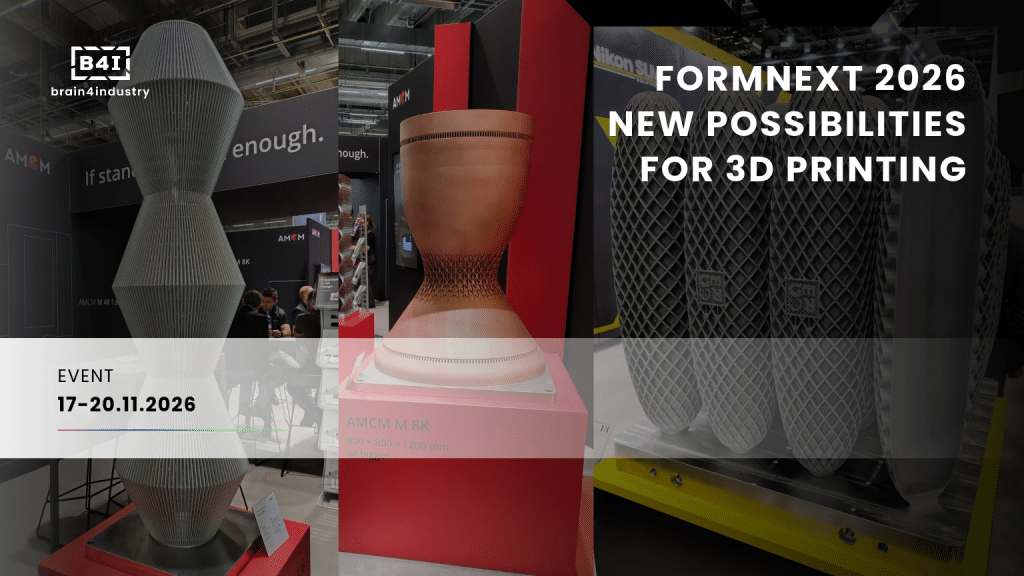
One of the most prominent trends was the increasing size of metal 3D printing systems. This development is driven largely by growing demand for large components in the aerospace industry, including parts for engines.
This is where additive manufacturing offers significant potential. It enables multiple individual components to be consolidated into a single printed part, reducing the number of joints, simplifying assembly and enabling complex geometries that would be difficult to produce using conventional manufacturing methods.
The build dimensions of these systems are reaching remarkable proportions. Farsoon offers solutions with a stated build volume of up to approximately 1.5 × 1.5 × 1.6 metres, while Eplus3D reports systems with build dimensions of up to 3 × 3 × 5 metres.
However, larger build volumes also come with greater financial demands. The amount of metal powder required to fill a build chamber of this size represents a substantial investment. The largest 3D printing systems are therefore often designed or customized for specific industrial applications where large-format additive manufacturing delivers tangible value.
Fewer Support Structures and Faster Printing
Another major topic was the reduction of support structures. In metal 3D printing, these structures are often essential for stabilizing components and dissipating heat during the build process. However, they also increase material consumption and post-processing requirements.
Renishaw showcased approaches to optimizing laser process parameters that enable certain overhanging geometries to be printed with fewer support structures.
Increasing productivity was another key area of focus. A notable example was the approach presented by EOS, which combines lasers with different spot sizes. A larger laser spot enables more productive processing of larger areas, while a smaller spot allows finer details to be produced with greater precision. The aim is to accelerate production while maintaining the required part quality.
Copper: A Material of Growing Interest in 3D Printing
Growing interest in copper 3D printing was also evident at Formnext. Thanks to its high thermal and electrical conductivity, copper is particularly suitable for applications such as heat exchangers, cooling components, and parts for electrical and propulsion systems.
Additive manufacturing also enables the production of complex internal channels and structures optimized for efficient heat transfer. However, successful copper 3D printing requires the selection of suitable laser technology, depending on the composition of the material being processed. Due to the high reflectivity of pure copper, specialized green lasers are used to process it, whereas in alloys such as CuNi2, the addition of nickel enables the use of conventional infrared lasers.
Not Just Larger, but Also More Accessible 3D Printing Systems
While most manufacturers focused on large-format systems, Farsoon also introduced its smallest metal 3D printer.
Compact systems of this kind may be particularly attractive to universities, research institutions and development centres. A smaller build volume reduces the amount of metal powder required, making experimentation, education and the development of smaller components more accessible.
From Technological Capabilities to Real Industrial Value
For industrial companies, what matters is not simply access to advanced technologies, but above all their return on investment and the value they bring to specific manufacturing applications. At Brain4Industry, we combine technological expertise with the practical needs of companies, helping them identify efficient solutions through additive manufacturing technologies.